

"Your goal shouldn't be to buy players. Your goal should be to buy wins."
That line is from the movie Moneyball! Delivered in the Oakland A's front office during one of the most quietly radical scenes in sports cinema. Peter Brand, played by Jonah Hill, is walking Billy Beane through sabermetrics: a way of measuring baseball value that ignored the scouts' gut instincts and looked instead at what actually correlated with winning games.
It's the scene where the movie pivots. Where traditional scouting gives way to data-driven decision making. Where Beane stops trying to replace his stars and starts hunting for market inefficiencies, players the rest of the league had mispriced, undervalued, or completely overlooked.
The lesson wasn't anti-player. It was anti-buying-the-wrong-things.
Which brings us to marketing in 2026.
We are now deep into the era of vertical versus horizontal AI. Most marketing teams have wired Claude,Claude Co-Work, ChatGPT, or Gemini into their daily workflow to boost productivity — drafting emails, summarizing meetings, rewriting briefs, generating campaign concepts. And that's working. And yes, we are seeing productivity gains.
But somewhere around the third coffee, a quieter question starts to surface which was:
Can I actually use this for analysis? For the decisions that move the number? For work where being wrong is expensive?
Because horizontal AI wasn't purpose-built for analysis. It was built to be broadly capable, not deeply accountable. And the gap between "looks like a good answer" and "is a defensible answer" is exactly where marketing budgets and yes credibility goes to die.

What does the data say?
This isn't just a hunch. McKinsey's QuantumBlack team named the exact pattern in their report Seizing the Agentic AI Advantage, and the numbers are staggering: nearly eight in ten companies have deployed gen AI in some form, but roughly the same percentage report no material impact on earnings. McKinsey calls this the "gen AI paradox" and they're explicit about the cause. McKinsey & Company
The main issue is an imbalance between "horizontal" and "vertical" use cases. The former, such as employee copilots and chatbots, have been widely deployed but deliver diffuse benefits,
Read that again. The tools every marketing team is currently betting on the horizontal copilots are the ones McKinsey is calling out as the source of the disappointment. Easy to scale, hard to measure, and largely disconnected from the metrics that actually matter to the business.
And McKinsey's playbook for closing it doesn't mince words: prioritize vertical use cases tied to core business metrics. Stop bolting AI onto existing workflows as a sidecar. Start embedding purpose-built agents with skills into the decisions that drive outcomes.
The Reframe
This is the Moneyball moment for marketing AI. The market inefficiency isn't on-base percentage any more. It's the widening gap between AI activity and AI outcomes. Between teams accumulating tokens, badges, and "AI-powered" line items on their stack diagrams, and teams actually buying wins: decisions grounded in their own data, verified against a source of truth, and defensible in front of a CFO.
So the question for every marketing leader right now is the same one Beane was asking in that front office:
Are you trying to buy players? Or are you trying to buy wins?
The Trap….Yea its productivity
Here is what’s convincing about horizontal AI, it feels like real analysis.
You paste a CSV into ChatGPT. It returns a clean summary, a few bullet points, maybe even a chart suggestion. You ask Claude why your conversions went up last quarter. It gives you a thoughtful, well-structured answer that sounds exactly like something a smart analyst would say.
The output looks like insight. It reads like insight. And in a world where marketers are drowning in dashboards, the confident “analysis” seems very fluent.
But fluency isn't accuracy. And in marketing analysis, the difference between the two is where careers and quarters get made or lost.
Where Horizontal AI Breaks Down
Once you move beyond "help me write this" and into "help me decide this," horizontal AI starts to crack in predictable, expensive ways:
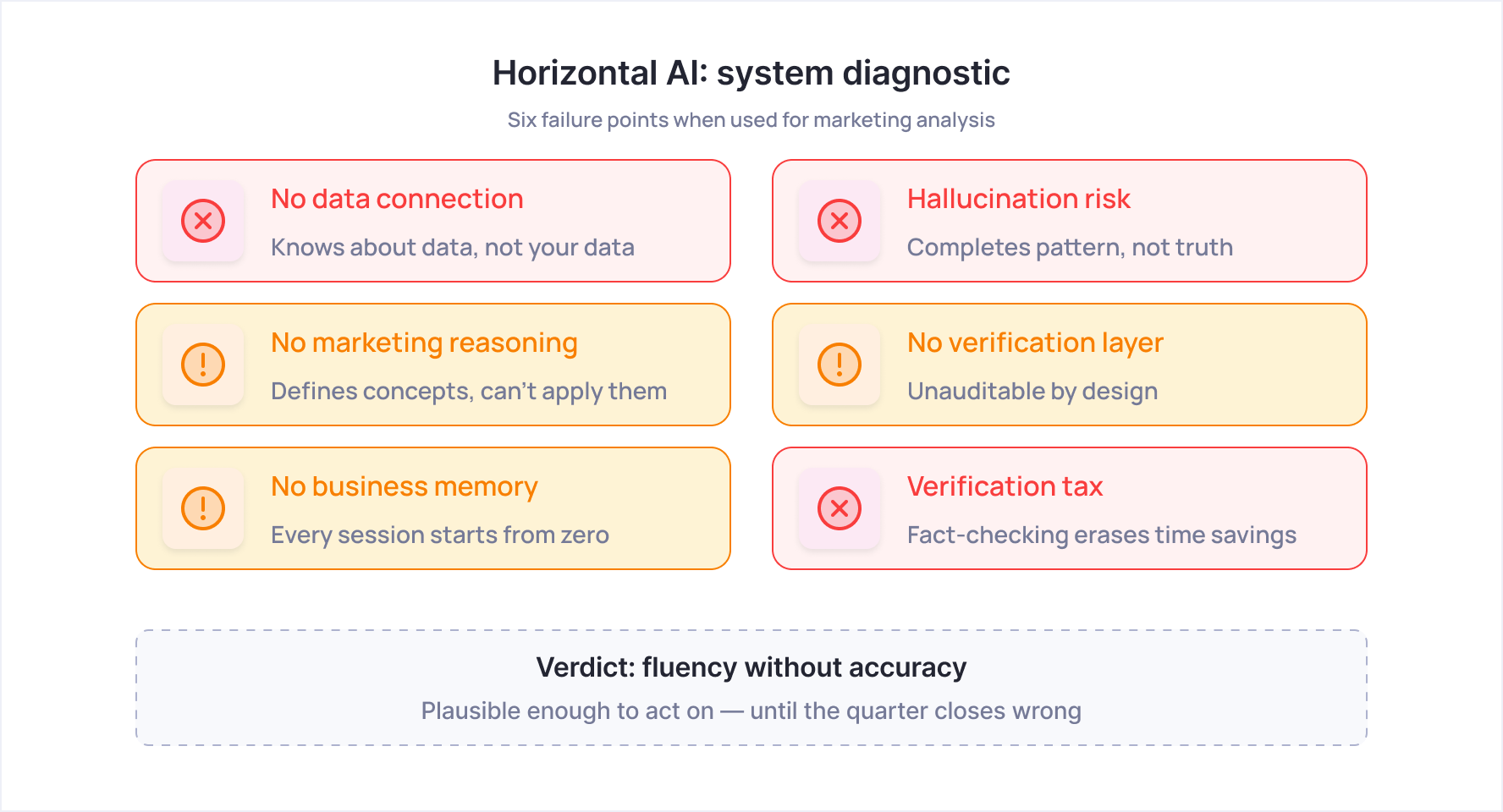
1. It doesn't know your data. It knows about data. A horizontal model has read every marketing blog ever written. It has not read your Salesforce instance, your GA4 property, your CDP, your warehouse, or your attribution model. Ask it "why did MQL-to-SQL conversion drop in Q3?" and it will give you a confident, generic answer about funnel hygiene and lead scoring none of which is grounded in your actual pipeline data.
2. It hallucinates with conviction. Horizontal models are optimized to complete the pattern, not to verify the truth. Ask one for a benchmark CTR for B2B SaaS paid social and it will give you a number. Whether that number is real, current, or sourced from anywhere credible is a coin flip. In productivity work, that's a typo. In analysis, that's a board slide built on fiction. Now imagine the confusion.
3. It doesn't understand marketing reasoning. Real marketing analysis requires understanding incrementality, attribution windows, statistical significance, channel interaction and correlation. Horizontal AI can define these concepts beautifully. It cannot apply them to your data with the rigor a decision requires. Ask it whether your brand campaign drove incremental revenue and watch it confidently confuse correlation with causation.
4. There's no verification layer. When a horizontal model gives you an answer, where did the number come from? Which table? Which join? Which time window? Which filter logic? You don't know. The model doesn't show its work and even if it did, it can't point to your source of truth, because it isn't connected to one. Every answer is unauditable by design. Hence there is no traceability.
5. It has no memory of your business. Your business has context: a fiscal calendar, a definition of "qualified lead" that took three quarters of debate to land on, a known seasonality pattern, a launch in May that distorted Q2 numbers. Horizontal AI forgets all of it the moment the chat closes. Every analysis starts from zero. Every answer is context-free.
6. The verification tax erases the time savings. Here's the punchline most teams discover the hard way: by the time a senior marketer has fact-checked, re-prompted, cross-referenced, and validated a horizontal AI's analytical output, they could have done the work themselves. The productivity gain is real for drafting. For analysis, it's often a wash or worse, a net negative if something slips through.
The Stakes
This is where McKinsey's "bolted on" framing becomes more than a metaphor. A horizontal copilot sitting next to your marketing workflow can summarize a meeting. It cannot tell you whether to shift $2M from paid search to another channel. And if you ask it to, the answer it gives will be confident, articulate, and unaccountable to anything.
In Moneyball terms: horizontal AI is the scout who watches a player swing and says "he looks like a ballplayer." It's pattern-matching on surface features. What Beane needed and what marketing leaders need now is the system that ties every decision to a verifiable outcome.
The risk isn't that horizontal AI gives you bad answers. The risk is that it gives you plausible ones. Plausible enough to act on. Plausible enough to put in a deck. Plausible enough that no one questions them until the quarter closes and the number is wrong.
Over time that's a trust problem. And trust is exactly what vertical agents are built to solve.
Why Vertical AI Beats Horizontal: Buying Wins, Not Players
Horizontal AI was designed to be impressive across a thousand domains. Vertical AI is designed to be right in one. And in marketing analysis, where every decision touches budget, pipeline, and pacing, being right is the only thing that compounds.
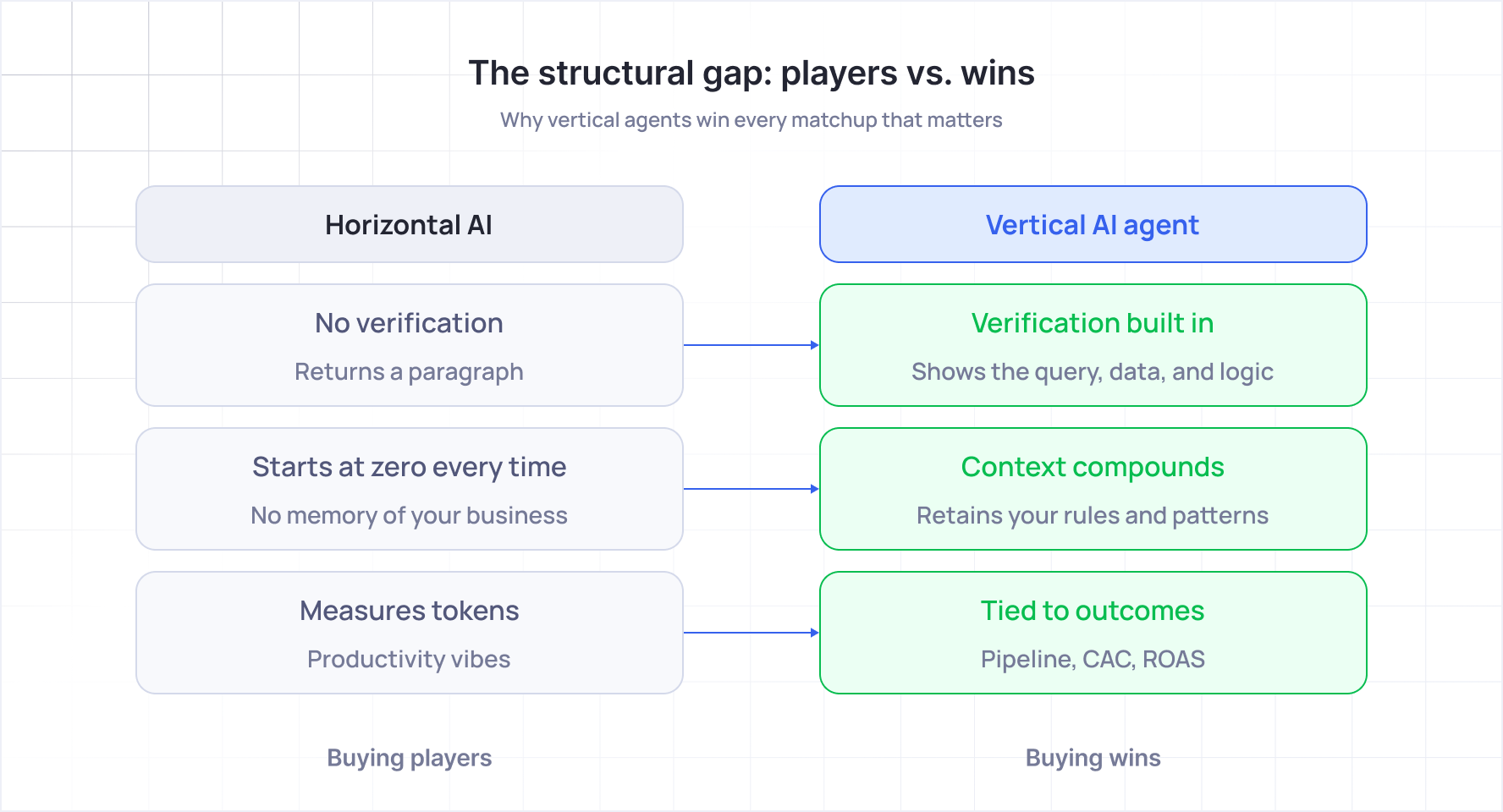
Here's why vertical agents win every matchup that matters:
1. Vertical Agents Have Verification Built Into the Architecture
This is the single biggest separator, and it maps directly to McKinsey's diagnosis. Vertical AI combines task planning, memory, tool orchestration, and human oversight including built-in skills, escalation, auditability, and feedback to ensure reliability and trust.
Yes, auditability and trust. These aren't features bolted onto a horizontal chatbot. They are the foundation a vertical agent is built on.
When a vertical marketing agent surfaces an insight, you can see the query it ran, the data it pulled, the assumptions it made, and the confidence it has in the result. When a horizontal model surfaces the same insight, you get a paragraph.
In a CFO conversation, one of those holds up. The other doesn't.
2. Vertical Agents Compound Context Over Time
Every horizontal AI conversation starts at zero. Every vertical agent conversation builds on what came before.
Your fiscal calendar, your seasonality, your launch dates, your KPI definitions, your last quarter's anomalies. A vertical agent retains and applies all of it. Which means analysis gets faster and more accurate the longer the agent is in production, not slower and more error-prone.
This is what McKinsey means when they describe agents as goal-driven systems that operate independently by breaking down complex tasks, interacting with other systems, and learning in real time.
3. Vertical Agents Are Tied to Outcomes, Not Tokens
Horizontal AI offers you capabilities. Vertical agent vendors sell you outcomes.
Prioritize vertical use cases tied to core business metrics. Not "deploy a copilot and see what happens." Not "give every employee an AI assistant and measure productivity vibes." Tie the agent to a skill that matters pipeline contribution, CAC, payback period, ROAS and
That's the Moneyball reframe in operational form. You don't buy the tool. You buy the win the tool produces.
So what's the decision going to be?
Buying wins doesn't mean ripping out the horizontal AI your team already uses. Claude, ChatGPT, Gemini. Yes, they are excellent at what they're built for. Drafting. Summarizing. Brainstorming. Productivity. Keep them. But let’s stop asking them to do things that they were never built to do.
Decisions where being wrong costs you a quarter, a campaign and organization credibility that work belongs to a vertical agent. An agent grounded in your data. An agent that shows its work. An agent that speaks marketing. One that compounds context.
So yes, horizontal for productivity and vertical for decisions.