
GTM teams have long suffered from a problem of their own tech stack's making which is siloed platforms, unintentional automation, and dashboards that report the score but never call the next play. The result is a GTM org that is simultaneously over-automated and under-aligned.
But for the first time, there is a real opportunity to fix that. Intentional AI and agents are all purpose-built to understand your vertical context, your metric definitions, and your business rules and can interpret metrics, surface specific recommendations, and route the right workflow to the right team at the right moment.
The opportunity isn't just faster decisions. It is a GTM org that finally moves as one.
A quick note before we get into it: I'm a football fan! Yes, go Seahawks! And the more time I spend thinking about GTM alignment, the more I keep coming back to one position and that is the Quarterback.
Not because it's a clever metaphor, but because the parallels are almost uncomfortably accurate. The QB's job isn't just to throw the ball. It's to ensure every player on the offense is operating from the same read, the same intent, the same next move. A great play call doesn't just tell the QB what to do, it aligns eleven people in a split second. That's exactly the problem GTM teams are trying to solve. So bear with me on the football references! I think they earn their place.
There's a reason the best quarterbacks in football aren't just great athletes. They are great thinkers.
After every play, a QB walks back to the sideline and does something that might surprise you: he looks at a tablet. He's reviewing the last snap. Who was open. Where the pressure came from. What the defense gave him that he didn't take. That review is valuable and it informs the next play.
But here's the catch: the play already happened. The result is captured. The yards are either gained or lost. No amount of film review changes what just occurred.
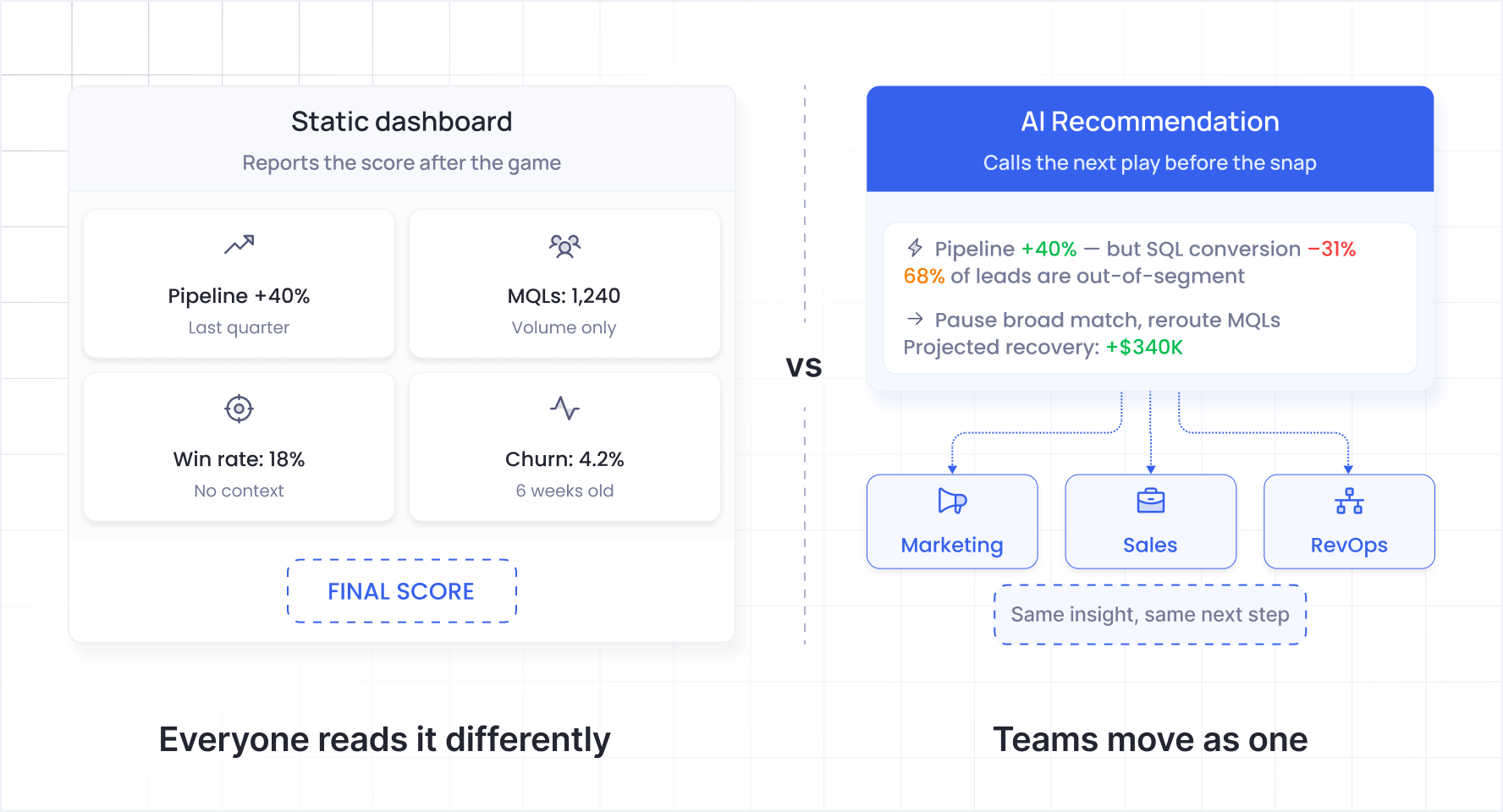
For years, this is exactly how GTM teams have operated. Dashboards were the tablet on the sideline filled with what already happened. Pipeline created last quarter. Deals lost last month. Churn from six weeks ago. Beautiful, well-built scorecards that told you one thing with precision: what the final score was.

The Static Dashboard Trap
Modern GTM teams are data-rich and insight-poor. Not because data is scarce, but because dashboards were built to report and not recommend.
Over time, the industry made this worse. Dashboards became prettier, visualizations more sophisticated, and operators gained access to better charts, filters, and drill-downs. But presentation quality started to get confused with decision quality. A polished pipeline waterfall or color-coded heatmap can feel like intelligence. It isn’t. It’s still a scoreboard! Just one that’s easier to misread.
Sales leadership sees that pipeline is up 40% quarter-over-quarter and assumes things are working. Marketing celebrates the volume. Leadership reports the growth. But underneath the headline, the composition has changed: pipeline concentrated in weaker segments, campaigns producing leads that rarely convert, and deal sizes quietly shrinking. The number went up but the quality went down.
By the time that reality surfaces, the quarter is already at risk. Sales works deals that won’t close, marketing doubles down on the wrong campaigns, and both teams point to the same dashboard to justify different conclusions.
This is the hidden tax of static intelligence: the gap between knowing and acting. When teams spend more time interpreting metrics than acting on them, alignment breaks down. Everyone sees the same dashboard but each team walks away with a different story.
Enter the Audible
The best QBs don't just review plays. They call audibles. They read what the defense is showing at the line of scrimmage, process it against everything they know as in the game plan, the opponent's tendencies, the down and distance and they make a decision before the snap. In real time. With intention.
This is the transformation AI makes possible for GTM teams.
Not AI as a chatbot. Not AI as a summarizer. AI as an operating layer that converts insights into recommendations and recommendations into workflows so that when a Marketing leader opens their Slack Channel or consumes an Agentic workflow on Monday morning, they aren't reading a dashboard. They're receiving a play call.
That's not a report on what happened. That's a decision made before the quarter slips, before Sales and Marketing end up in the same misalignment conversation again, and before the pipeline number that looked like a win turns into a miss.
Intentional Agents: The Engine Behind the Audible
The word 'AI' gets used loosely in GTM conversations. It's worth being precise about what actually makes the audible possible because a general-purpose language model running against your CRM data is not it.
What makes the difference is intentional AI and agents which are all purpose-built systems that are loaded with your vertical context before they ever touch a signal. Not a model that reads your data and summarizes it. An agent that understands what your data means.
There is a critical distinction here. A general-purpose AI sees a metric change and describes it. An intentional agent sees the same metric change and interprets it because it already knows your segment definitions, your historical conversion benchmarks, your ICP criteria, and the business rules your team has established over years of operating.
It knows that a 40% MQL increase in your enterprise segment means something completely different than a 40% increase in your SMB segment. It knows which thresholds are significant and which are noise. It knows who needs to be notified and when.
That's not a summary. That's vertical reasoning and it's only possible because the agent was built to understand your context, not a generic version of your data and market.
What Agents Actually Do
In practice, intentional GTM agents operate across three layers simultaneously:
They monitor for shifts. Continuously watching your metrics against your defined thresholds and not waiting for someone to pull a report, but detecting changes the moment they emerge.
They interpret against context. Cross-referencing what changed against your metric definitions, your business rules, and your historical patterns to determine whether a signal is meaningful, urgent, or noise.
They generate and route recommendations. Translating the interpreted insight into a specific, actionable recommendation and routing it to the right person at the right time, governed by your access controls.
The result is a GTM motion where no significant insight falls through the cracks, no team interprets a metric in isolation, and no recommendation arrives without the context needed to act on it immediately.
This is what separates intentional AI from a smarter dashboard. A dashboard waits to be read. An agent is already working.
What separates generative noise from genuine GTM intelligence is grounding. Any AI can surface patterns but patterns without context are just suggestions to ignore. The teams pulling ahead aren't the ones with the most AI. They're the ones with AI that knows their business.
The Shift in Practice: What Marketing Knew Before Sales Had to Ask
Think about what intentional AI looks like at the top of the funnel where pipeline is created, and where misalignment between Marketing and Sales is most expensive.
A campaign goes live. Traditional dashboards tell you eventually how many MQLs it generated, cost per lead, and form fill rates. You get the scoreboard after the game.
Marketing celebrates volume. Sales complains about quality. Neither team is wrong. But they are not aligned either, because they're reading the same static report and optimizing for different things.
An AI layer grounded in your metric definitions does something different. It doesn't wait for the post-mortem. It reads early engagement signals against your historical conversion benchmarks in real time and surfaces a recommendation before the pipeline number is even populated:
That single recommendation does something a dashboard never could: it creates a shared context across teams.
Marketing isn't defending volume numbers. Sales isn't complaining about lead quality in a vacuum. Both teams are looking at the same AI-generated insight and recommendation, grounded in the same metric definitions, routed through the same business rules. The conversation shifts from 'whose fault is this?' to 'what do we do next?'
Recommendations as Alignment Infrastructure
When an intentional agent surfaces a recommendation, it isn't just suggesting an action. It's publishing a shared version of truth and one that every downstream team operates from, rather than their own siloed reading of raw data.
That alignment has compounding effects:
- Marketing isn't defending volume numbers. Sales isn't complaining about lead quality in a vacuum. Both teams are looking at the same AI-generated insight, grounded in the same metric definitions, routed through the same business rules. The conversation shifts from 'whose fault is this?' to 'what do we do next?'
- Sales leadership can see that the opportunity entering their pipeline came from a reallocated campaign by giving them full context on intent and persona before the first call, without anyone having to brief them manually.
The recommendation becomes the connective tissue. And the workflow attached to it and the re-routing, the sequence switch, the budget reallocation is what turns alignment from a talking point into a motion.
Capturing the Changes, Not Just the State
There's one more shift that matters here: the best GTM AI doesn't just read where things stand. It reads what changed.
A static dashboard shows you today's MQL count. An intentional AI layer shows you that MQL count dropped 34% week-over-week in a segment that was previously your highest-converting, and flags it before anyone notices it in a Monday morning review.
Those deltas — the changes between what was true yesterday and what is true now — are where urgency lives. And urgency, routed through the right workflow to the right person at the right time, is what moves pipeline forward.
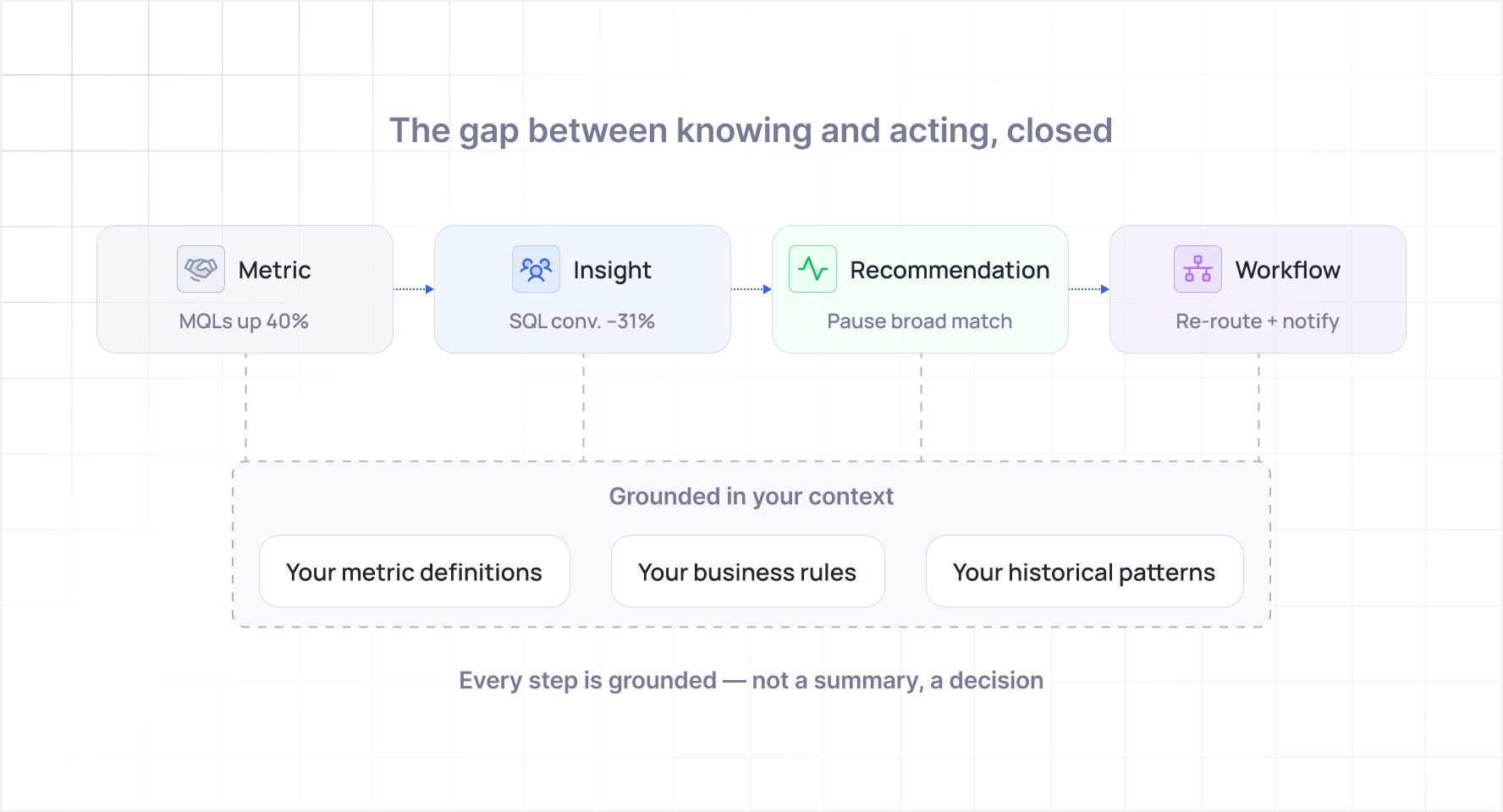
That chain — from metric to insight to recommendation to workflow — is what closes the gap between knowing and acting. And it only works because every step is grounded in your definitions, your rules, and your knowledge.
The New Competitive Moat
Here’s the uncomfortable truth for GTM leaders: the race is no longer about who has the most tools or the most data. Everyone has plenty of both.
Connected AI agents grounded in your business definitions and metrics connecting insights, adding context, and turning data into decisions faster.
Think of a quarterback. The one who studies film after the game is a great historian. The one who reads the defense at the line and calls the right audible is a completely different player.
That’s where AI agents come in. When agents are connected across your systems and grounded in how your business actually measures pipeline, segments, and conversion, they move beyond dashboards. They continuously interpret what’s happening and surface the next best action before the window closes.
That’s the audible the moment before the snap where your GTM team shifts from reacting to deciding, and where Marketing and Sales leaders finally operate from the same playbook instead of three different readings of the same scoreboard.